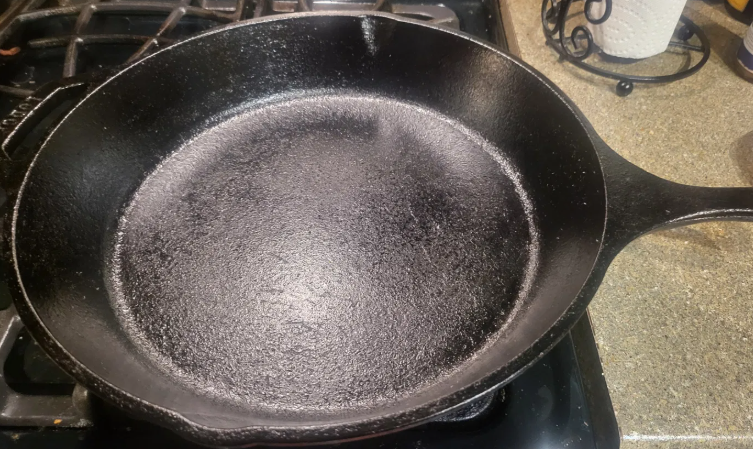
ED-001: THE HERESY
The heresy is not using cast iron. The heresy is believing that the pan is the point.
The pan is not the point. The mechanism is the point. A well-seasoned 10.25" Lodge skillet from a department store performs every sear in this archive with identical results to a $400 heirloom pan. The protocols do not require expensive equipment. They require equipment that does not fight the technique.
This document explains the mechanism, settles the soap debate, and cross-references every protocol in the archive that depends on cast iron doctrine.
Seasoning is not a coating. It is a chemical transformation. When fat is heated above its smoke point on a porous iron surface, the fat molecules undergo polymerization — they cross-link into a hard, plasticized layer that bonds to the iron at the molecular level. This layer is hydrophobic, nonstick, and self-reinforcing. Every cook at sufficient heat adds another layer. The pan does not wear out. It improves.
The enemy of seasoning is not soap. The enemy of seasoning is water left in contact with bare iron, and heat applied unevenly before the oil has fully polymerized. A brief wash with modern dish soap — which uses synthetic surfactants, not the lye-based compounds that originally gave cast iron its reputation for fragility — does not dissolve a well-built seasoning layer. The surfactants cannot break a polymerized bond.
Dish soap cannot touch it. What can touch it: leaving it wet, storing it damp, or cooking high-acid ingredients in a pan whose seasoning is not yet established.
On seasoning: Every cook adds a layer. Every layer makes the surface smoother, more nonstick, and more heat-retentive. A new pan is not ready. A used pan is ready. Use it.
On rust: Rust is surface oxidation. It is not damage. Remove it with a steel wool pad, re-season with a thin coat of oil at 450°F for one hour, and continue. The pan is not ruined. It has been interrupted.
On preheat: Cast iron requires 4–5 minutes over medium heat before introducing protein. A cold pan produces grey, steamed chicken, not a sear. The water test: a drop of water flicked into a properly heated pan evaporates in under 2 seconds. That is your signal.
On heat retention: Cast iron does not heat fast. It heats slowly and holds. Once hot, it stays hot when the protein hits it. Stainless drops temperature on contact. Cast iron does not. That is the mechanism behind every sear in this archive.
| TECHNIQUE | MECHANISM | PROTOCOLS |
|---|---|---|
| Cold Start | Cold pan → protein → medium heat. Fat renders slowly before Maillard begins. No thermal shock. | PP003PP007 |
| High-Heat Sear | 4–5 min preheat over medium-high. Cast iron holds temperature on protein contact. Stainless does not. | PP002PP006PP008PP010 |
| Deglaze Recovery | Fond adhered to iron surface dissolves into liquid on contact. Water, stock, or acid carries flavor forward. | PP006PP007PP008PP013 |
| Acid Indifference | A well-seasoned pan resists acid leaching for short cook durations. Tomatoes under 20 minutes leave seasoning intact. | PP004PP009 |
Nonstick Pan
A nonstick surface prevents Maillard reaction adhesion. The brown fond that builds on cast iron during a sear is a flavor compound. Nonstick releases it into the atmosphere. You are discarding the most flavorful part of the cook.
INADMISSIBLE FOR SEAR OPERATIONSCanola Oil (for high-heat sear)
Canola oil has a smoke point of approximately 400°F. A proper sear requires 450°F+. At that temperature, canola breaks down and produces acrolein — the compound responsible for the bitter, acrid quality in oversmoky pans. Use avocado oil (520°F), rice bran oil (490°F), or clarified butter.
CLEARED FOR LOW-HEAT OPERATIONS ONLYCast Iron Soap Wash
Modern dish soap is not the lye soap that originally damaged cast iron seasoning. A brief soap wash does not strip a well-seasoned pan. However: the dish-soap debate is the wrong conversation. The correct conversation is: dry completely, coat lightly with oil immediately after wash, and store uncovered. The seasoning builds over time from use.
CHARGE PARTIALLY WITHDRAWN — SEE CARE PROTOCOLPre-Heating in Cold Oven
Cast iron expands and contracts with temperature change. Cold pan to 500°F oven is a rapid thermal event. A well-maintained pan survives this. A pan with microfractures — invisible to the eye — may not. The stovetop preheat over medium heat for 4–5 minutes eliminates the thermal shock variable and gives you visual confirmation that the pan is at temperature.
INADVISABLE — USE STOVETOP PREHEAT PROTOCOLEvery protocol in the archive documents which cast iron technique it uses, why, and what the mechanism produces. The equipment is the platform. The protocol is the intelligence.